



HealthAffaire
  • Causes and Cure
  • Myths & Facts
  • Lifestyle and Wellness
  • Diet and Nutrition
Reading: How to Relieve Stress: A 6-Step Plan to Feeling Good in 2026
Share
Font ResizerAa
HealthAffaireHealthAffaire
  • Mind & Brain
Search
  • Home
  • Categories
    • Mind & Brain
  • More Foxiz
    • Blog Index
    • Forums
    • Complaint
    • Sitemap
Follow US
Made by ThemeRuby using the Foxiz theme. Powered by WordPress
Home » Blog » How to Relieve Stress: A 6-Step Plan to Feeling Good in 2026
Mind & Brain

How to Relieve Stress: A 6-Step Plan to Feeling Good in 2026

By hawk
Last updated: March 15, 2026
4 Min Read
Share
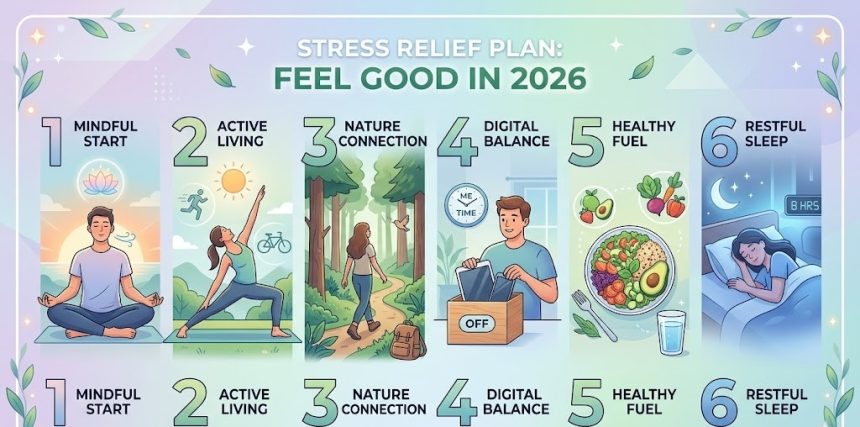
How to Relieve Stress: 6-Step Plan for Resilience in 2026

In 2026, as digital saturation and “always-on” culture reach new heights, managing your mental health has become a critical skill for longevity. According to Johns Hopkins stress management expert Frances Callahan, LCSW-C, stress is inevitable, but when managed correctly, it can actually foster emotional and intellectual growth.

Contents
  • The 6-Step Resilience Roadmap
    • 1. Identify Your Specific Triggers
    • 2. Stay Connected with Your Tribe
    • 3. Channel Stress Through Movement
    • 4. Find Your “Pause” Button
    • 5. Plan Your Fun (Don’t Wait for It)
    • 6. Reframe Stress as a Tool
  • Relevant Resources for Stress Management

Follow this easy-to-implement 6-step plan to regain your calm and build lasting resilience.

The 6-Step Resilience Roadmap

1. Identify Your Specific Triggers

Stress often feels like a vague cloud, but it usually has a concrete source. Whether it’s a demanding workload, a strained relationship, or health anxiety, identifying the “why” is the first step toward the “how.”

  • Action: Take a moment for focused thought. If a relationship is a trigger, try adjusting your expectations or stepping back. If the trigger can’t be changed, a shift in perspective can mitigate the emotional impact.

2. Stay Connected with Your Tribe

Healthy relationships are a powerful buffer against the wear and tear of daily life. Supportive friends, family, faith communities, and even pets provide the emotional scaffolding needed to stay energetic and positive.

  • Action: Make an effort to maintain and improve your social bonds. Even if family isn’t nearby, reaching out to neighbors or local groups can promote social resilience.

3. Channel Stress Through Movement

Physical activity is a biological “shortcut” to feeling better. It releases endorphins that naturally improve mood and act as a reset button for the nervous system.

  • Action: You don’t need a marathon. Short walking breaks several times a day are effective. Joining a yoga, dance, or tai chi class doubles the benefit by keeping you connected with others.

4. Find Your “Pause” Button

In a world of high demand and constant change, rest is not a luxury—it’s a requirement. Creating space for contemplation and deep breathing fosters a sense of internal calm that protects you from burnout.

  • Action: Practice the power of saying “no” to extra requests for help or social invitations. Dedicate time daily for reflection and quietude.

5. Plan Your Fun (Don’t Wait for It)

If you don’t schedule joy, the daily rush will likely consume your time. Anticipating a positive event can be just as beneficial for your mental state as the event itself.

  • Action: Instead of aimless scrolling, make a “date” to watch a special program, plan a monthly game night, or identify a hobby that suits you and put it on your calendar.

6. Reframe Stress as a Tool

Paradoxically, “stressing about stress” makes the physical symptoms worse. Your body’s stress response—a faster heart rate and quicker breathing—actually evolved to help you perform better under pressure.

  • Action: Remind yourself of the evolutionary value of these sensations. Accepting the physical response can improve your performance and reduce the overall feeling of being overwhelmed.

Relevant Resources for Stress Management

  • Johns Hopkins: Managing Stress Eating: Expert advice on how to stop using food as a primary coping mechanism.
  • Harvard Health: Understanding the Stress Response: A scientific deep dive into the “fight-or-flight” biology and how to calm it.
  • Mayo Clinic: Yoga for Stress Relief: A practical guide on using yoga poses to reduce anxiety and tension.
  • NAMI: Managing Stress: Comprehensive resources for those dealing with chronic stress and mental health challenges.

Also Read : Citrus Peels for Healthy, Glowing Skin — How and Why They Work

TAGGED:emotional resiliencehow to reduce stressJohns Hopkins stress tipsphysical activity for stressstress management plan 2026

Sign Up For Daily Newsletter

Be keep up! Get the latest breaking news delivered straight to your inbox.
[mc4wp_form]
By signing up, you agree to our Terms of Use and acknowledge the data practices in our Privacy Policy. You may unsubscribe at any time.
Share This Article
Facebook Email Copy Link Print
Leave a Comment Leave a Comment

Leave a Reply Cancel reply

Your email address will not be published. Required fields are marked *

SUBSCRIBE NOW

Subscribe to our newsletter to get our newest articles instantly!
[mc4wp_form]

HOT NEWS

A high-resolution digital render of spirulina powder spiraling into a glass of water, highlighting its vibrant green phycocyanin pigment and nutrient density.

Spirulina: Bio-Nutritional Efficacy and Global Market Dynamics

In the global wellness and nutraceutical sectors of 2026, the adoption of high-density superfoods has…

April 25, 2026

Important Difference Between Brain and Mind

Quantum science emerged from studies of the smallest objects in nature. Today, it promises to…

November 9, 2022

Start Your Day With Breathing Exercises for Stress Relief

Quantum science emerged from studies of the smallest objects in nature. Today, it promises to…

November 9, 2022

YOU MAY ALSO LIKE

Astronomers Find Shell Structures in Milky Way Galaxy

Quantum science emerged from studies of the smallest objects in nature. Today, it promises to deepen our understanding of the…

Mind & Brain
November 3, 2022

What are the Units of Astronomical Measurement?

Quantum science emerged from studies of the smallest objects in nature. Today, it promises to deepen our understanding of the…

Mind & Brain
November 3, 2022

Effect of Environmental Factors on Intelligence Quotient

Quantum science emerged from studies of the smallest objects in nature. Today, it promises to deepen our understanding of the…

Mind & Brain
November 3, 2022

The Region’s Leaders in Brain & Spine Care

Quantum science emerged from studies of the smallest objects in nature. Today, it promises to deepen our understanding of the…

Mind & Brain
November 5, 2022
We use our own and third-party cookies to improve our services, personalise your advertising and remember your preferences.
  • Jobs Board
  • About Us
  • Contact Us
  • Privacy Policy
  • Exclusives
  • Learn How
  • Support
  • Solutions
  • Terms And Conditions
  • Editorial Policy
  • Marketing Solutions
  • Industry Intelligence

Follow US: 

HealthAffaire 2026 | All Rights Reserved

Welcome Back!

Sign in to your account

Username or Email Address
Password

Lost your password?